Reviewed by Nir Tal — August 13, 2026
Safety is the first question many people ask when considering cycling in Los Angeles, and it deserves a straight answer.
The honest reality: cycling in LA carries real risk in certain environments and is genuinely safe in others. The gap between those two situations is almost entirely about route selection, visibility gear, and bike condition. Cyclists who ride on dedicated infrastructure with properly functioning equipment and good lighting face a very different risk profile than cyclists on high-speed arterials without lights at night.
This guide covers what the data says, where the safest routes are, and what every LA cyclist can do practically to reduce risk before the first pedal stroke.
What does the crash data say about biking in LA?
Los Angeles has one of the higher cyclist fatality rates among major US cities. The city and county track this data through SWITRS (Statewide Integrated Traffic Records System), and the patterns are fairly consistent year over year.
Where serious incidents happen:
- High-speed arterials (Sepulveda Blvd., Venice Blvd., Olympic Blvd., Wilshire Blvd. in sections without protected lanes)
- Nighttime riding without lights
- Intersections where cyclists are not clearly visible to turning vehicles
- Riding against traffic
- Riding in door zones of parked cars
What this means practically: The risk in LA is concentrated and to a significant degree avoidable. Cyclists who use dedicated infrastructure, ride with proper lighting, stay predictable at intersections, and keep their equipment in good condition are removing themselves from the highest-risk categories.
The data does not support the conclusion that cycling in LA is universally dangerous. It supports the conclusion that specific behaviors and route choices carry significantly elevated risk. That distinction matters.
Where is it safest to bike in Los Angeles?
Car-Free and Separated Paths
The Marvin Braude Bike Trail is the gold standard for safe LA cycling. The 22-mile coastal path from Pacific Palisades to Torrance Beach is entirely separated from motor traffic for most of its length, flat, well-lit in the Santa Monica and Venice segments, and heavily used by cyclists of all levels. The risk profile on The Strand is comparable to any dedicated multi-use path in the United States.
The Ballona Creek Bike Path (7.5 miles east from the beach to Culver City) and segments of the LA River Bike Path offer similar separated-path safety.
Risk level on these routes: Low. The primary hazard is conflict with pedestrians at peak hours, not motor vehicles.
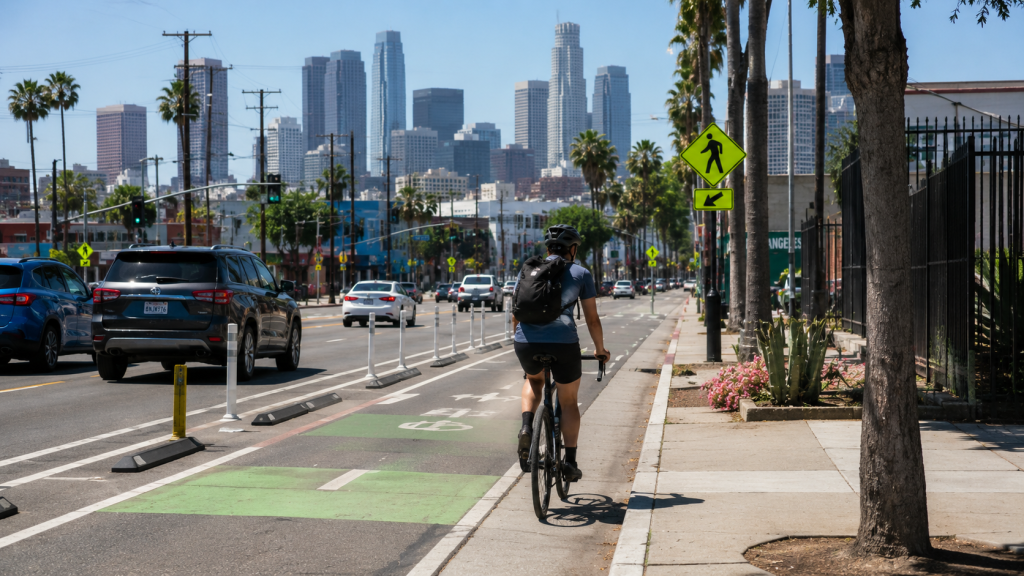
Protected Corridors in Santa Monica and West LA
Santa Monica has invested in protected bike infrastructure on a number of corridors and has a strong enforcement culture around bike lane compliance. West LA’s lower-speed residential streets, San Vicente Boulevard, and the canyon routes (Mandeville, Topanga) have low traffic volumes and manageable conditions for experienced road cyclists.
Risk level: Low to moderate depending on the specific street and time of day.
The South Bay (Manhattan Beach, Hermosa Beach, Redondo Beach)
The South Bay’s cycling infrastructure, anchored by the southern end of the Marvin Braude Trail, makes it one of the safest cycling environments in the LA area. These are also among the most active road cycling communities in Southern California, with strong group ride cultures that provide safety in numbers.
Risk level: Low on paths and established corridors; moderate on cross streets.
Higher-Risk Scenarios to Understand
Major Arterials Without Protection
Streets like Sepulveda, Venice Blvd., Pico, and Olympic carry high traffic volumes at speed. Painted bike lanes on these streets without physical separation from traffic lanes create a false sense of protection. These corridors require vigilance, predictable riding, and experience. They are not the right introduction to LA cycling for new riders.
Nighttime Riding Without Lights
California law requires a white front light and a red rear reflector or light for cycling after dark. Beyond legal compliance, the visibility differential between a lit and unlit cyclist on an LA street is substantial. Front and rear lights are a higher safety return per dollar than almost any other cycling expenditure for urban riders.
Rush Hour on Commuter Corridors
Rush hour on LA streets concentrates distracted driving, aggressive behavior, and door-zone risk. For cyclists who commute, later morning departures (after 9 AM) and earlier afternoon departures (before 4:30 PM) materially reduce exposure to peak traffic conflict.
Practical Safety Measures for LA Cyclists
Route planning before the ride
LA’s cycling infrastructure is uneven, and routes that look direct on a regular map may route cyclists through high-speed arterials. Tools like Google Maps cycling mode, Komoot, and the LADOT Bike Map identify lower-traffic alternatives. Five minutes of route planning before a new ride in LA is a meaningful safety investment.
Lights: non-negotiable
Front and rear lights are required by California law at night and should be used any time visibility is reduced, including dawn, dusk, overcast days, and tunnels or underpasses. A rechargeable USB light kit with at least 200 lumens front and a flashing red rear covers all situations.
Helmet fit
A helmet that does not fit correctly does not provide effective protection. A helmet should sit level, two fingers above the eyebrows, with a snug chin strap fit. Bike Improve can assess fit when purchasing a new helmet.
Bike maintenance
A bike with worn brake pads, loose headset, or slipping derailleur is a meaningful safety risk in urban traffic. Unpredictable braking in a car-door scenario or at a busy intersection is the difference between a close call and an incident. A tune-up at bike-improve before a new cycling season, or after any extended period off the bike, is a practical safety step, not just a performance one.
Bike fit for control
Cyclists who are uncomfortable on their bike, reaching too far forward, or sitting too high or low, carry physical tension that degrades bike handling and reaction time. Pain in the knees, back, or wrists is a sign that fit needs attention. A professional fit at Bike Improve addresses the biomechanics that directly affect control and comfort in traffic.
Gear visibility
High-visibility cycling clothing, particularly for dawn, dusk, and overcast winter riding, makes a demonstrable difference in how early approaching drivers detect a cyclist. This is especially relevant on LA streets where driver attention is often divided.
Kids and Family Cycling Safety in LA
LA is manageable for family cycling within the right corridors. The Marvin Braude Trail is the most practical family cycling destination in the region. Santa Monica’s protected infrastructure makes short neighborhood rides and beach-path sessions achievable for cyclists of all ages.
Key considerations for family rides:
- Stick to separated paths and low-traffic neighborhood streets.
- Helmets are legally required for riders under 18 in California and should always be worn.
- Kids’ helmets should be replaced after any impact, regardless of visible damage.
- Front and rear lights for any ride near dusk.
The accessories section includes helmets for road, MTB, and children, from Scott, Lazer, Rudy Project, and POC.
The Bottom Line on LA Bike Safety
Cycling in Los Angeles is as safe as the choices cyclists make before and during the ride. The city has genuine infrastructure that supports low-risk cycling on specific corridors. It also has streets that require experience, preparation, and attention.
For new riders, the safest approach is to start on separated paths, build experience on lower-traffic residential streets, and progress to mixed-traffic corridors with proper gear and a well-maintained bike. For experienced cyclists, route awareness, lighting, and regular mechanical upkeep are the highest-return safety investments.
Bike Improve: West LA’s Full-Service Shop
Bike Improve handles everything that makes LA cycling safer and more enjoyable, from pre-season tune-ups to professional bike fits to accessories for visibility and protection.
- Service and mechanical safety
- Helmets, lights, and visibility gear
- Bike fit for control and comfort
- Custom wheels for serious LA riding
Come in at 10927 Santa Monica Blvd., Los Angeles, CA 90025.
Hours: Sunday to Friday, 11 AM to 5 PM, closed Saturday. Phone: (310) 400-0363
Frequently Asked Questions
Professional bike fitting, suspension tuning, custom builds, and premium servicing designed for riders who demand more from every ride.